This summer, spending long hours at the helm of Sea Kelp was supposed to be pure relaxation. Instead, after several trips out on the water, I kept coming back to the dock with massive, throbbing headaches and a scary difficulty seeing. At first, I couldn’t figure out what was going wrong—this was a major problem that needed a quick answer.
It turns out I was experiencing a temporary but painful condition known as photokeratitis, commonly called snow blindness. While most people associate this with alpine skiing or frozen tundras, the exact same threat exists on the open water. Snow blindness is essentially a sunburn on the surface of your eyes, caused by overexposure to ultraviolet (UV) rays. The sun’s rays reflect powerfully off the water’s surface, doubling the dose of radiation your eyes receive. Symptoms include intense pain, light sensitivity, blurry vision, and a gritty feeling in the eyes, often hitting you hours after you leave the water.
The confusing part was that I never left the helm without my Maui Jim sunglasses. I thought my eyes were fully protected. However, my doctor recently educated me on what was actually happening: standard sunglasses often leave the sides and top open. The intense glare from the water was bouncing off the white fiberglass decks, hitting the inside surface of my lenses from the back and sides, and reflecting directly into my eyes completely unfiltered.
This doctor’s visit also taught me a lot about lens categories. Most high-quality everyday sunglasses use Category 3 lenses. These are great for general use, filtering out roughly 82% to 92% of visible light. But in extreme environments with massive reflection, you need an extra level of protection.
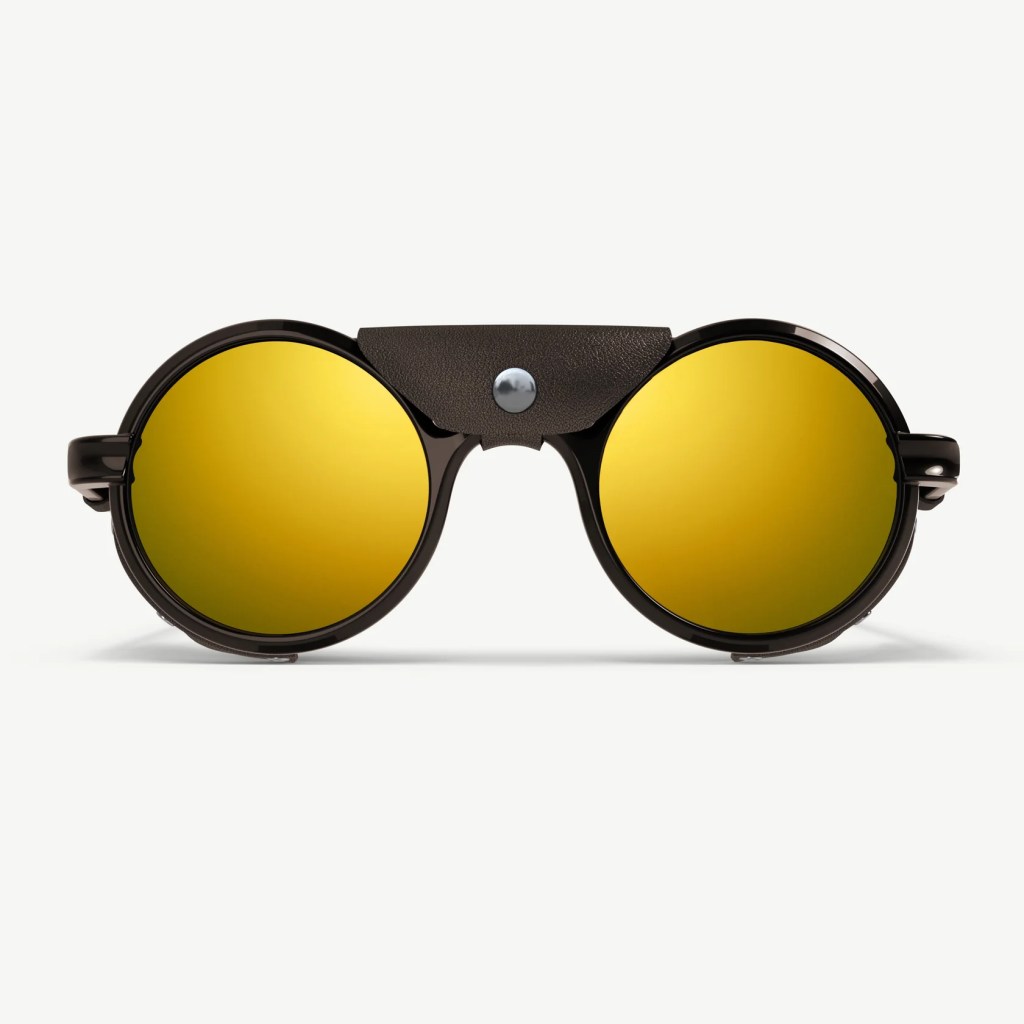
To fix this, I switched to the Heron Glacier glasses from VALLON. These are equipped with ultra-dark Category 4 lenses. A Category 4 lens lets in only about 5% to 7% of visible light. Because they block so much more light, they are actually illegal to wear while driving! Combined with authentic leather side shields that completely block out dangerous peripheral glare and rear reflection, they offer total coverage. Protecting your eyes on a boat requires more than just dark lenses; it requires the right category of defense. Moving forward, these are going to be a mandatory piece of safety gear on Sea Kelp.
The Great American Loop is an endurance match. It is not just a test for your boat’s machinery, but a continuous trial of the crew’s mental and physical stamina. When you are living on a boat and traveling for a solid year, major mechanical catastrophes are rare. Instead, it is the low-level, daily friction points—the constant small annoyances, complex workarounds, and physical discomforts—that slowly erode your energy.
Our core strategy for preparing Sea Kelp can be summed up in one time-tested rule: KISS (Keep It Simple, Stupid) and Comfortable.
If you look at modern boat show models or flashy cruising blogs, it is easy to get sucked into a world of hyper-complex automation and specialized digital gadgets. But we look at those items and see one thing: a long list of expensive failure points waiting to break in a remote river lock. How the boat looks under flawless dock lighting is simply not as important as how you feel when you are using it day in and day out on a massive voyage. Every system on Sea Kelp must earn its place by reducing our daily stress, not adding to our maintenance logs.
🌊 The Shakedown Crucible: Exposing Reality Underway
You can sit at the marina slip all winter mapping out ideas on a legal pad, but the dock is a liar. It shields your boat from currents, masks your electrical draws, and hides acoustic vibrations. We didn’t learn the lessons of Sea Kelp by guessing; we learned them by forcing the boat into the real world through a rigorous internal audit and dedicated shakedown cruises.
Our recent shakedown cruise around the Delmarva Loop was designed with one strict goal: stress-test our gear usage, evaluate our functionality as a two-person crew, and aggressively hunt down mechanical errors. It was out on the open water—facing shifting currents, navigating busy channels, and watching how the boat handled under real loads—that the true friction points stepped into the light.
The shakedown cruise is a crucible. It forces you to realize that if a system or piece of furniture makes your life difficult during a one-week trial run, it will absolutely break your spirit on a year-long voyage. Every demolition project, electrical upgrade, and mechanical repair that followed was a direct answer to the challenges the water threw at us.
🛋️ Reclaiming the Salon: The 500-Pound Sofa Demolition
Simplicity is heavily defined by what you choose to throw away. When we first stepped into the salon of Sea Kelp, it felt cramped, completely cutting into the excellent natural beam of the hull. The culprit was a massive, brutally heavy household sleeper sofa installed by a previous owner. While a fold-out bed sounds convenient on paper, it took up far too much premium real estate for a two-person crew. It had to go.
There was just one massive problem: the boat’s tight doors, sharp cabin angles, and steep companionway stairs made it physically impossible to carry out in one piece. We honestly have no idea how they managed to get it inside the cabin originally. This mechanical monster easily weighed over 500 pounds!
Instead of breaking our backs trying to force it through a tiny companionway door, we applied our core philosophy. We grabbed a power saw and cut the entire sleeper sofa into manageable pieces right there in the salon.
Once the heavy metal frame and dusty upholstery were hauled away, a real surprise was waiting for us underneath. We noticed a hidden hatch that had been completely trapped beneath the couch’s massive footprint. We pried it open, expecting more grime or abandoned clutter. Instead, we found a time capsule: a complete, comprehensive mechanic’s tool set—wrenches, screwdrivers, and a full socket set. They were entirely brand new and had never turned a single bolt.
It makes you wonder about the mindset of a previous owner who buys a proper tool kit, deliberately buries it under a 500-pound sofa where it can never be reached in an emergency, and chooses to leave years of maintenance completely deferred.
Worse yet, that immovable sofa had acted like a giant hair trap for years. The previous owners traveled with a shedding dog. By the time we finished vacuuming and scraping out the structural corners under the newly cleared deck hatch, we filled two full contractor trash bags with nothing but dog hair.
Evicting that beast did three incredible things for our Loop preparation:
Reclaimed Real Estate: We now have a wide-open salon layout where we can actually move around without tripping over bulky household furniture.
Purged the Boat’s Climate: Removing decades of hidden pet dander instantly improved the indoor air quality and eliminated that lingering “wet dog” smell.
Exposed Critical Infrastructure: Opening that hatch gave us total access to inspect our lines, structural supports, and wiring runs that had been ignored for years.
🍹 Grace, Grit, and Misplaced “Fuel Hacks”
It is easy to look at a buried hatch and an engine room full of clutter and judge the choices made before you. But if we are being completely honest, we have to give the previous owner some grace.
Before we bought Sea Kelp, the boat belonged to a young guy living aboard with his girlfriend right in the heart of Spa Creek in Annapolis, Maryland. When you tied up next to the Chart House in the middle of one of the premier sailing capitals of the world, it is incredibly easy to get swept up in the romantic vision of living the ultimate, carefree Jimmy Buffett lifestyle.
But the stark reality of owning a substantial trawler eventually catches up to everyone. Anyone who has owned a vessel knows that boat projects are a lot like a spouse’s “honey-do” list—they are never-ending. A boat that carries 500 gallons of diesel and demands an almost continuous schedule of maintenance will quickly overwhelm a young couple trying to live a simple life on the water. When budget and time get tight, critical maintenance gets deferred.
Worse yet, it leads to desperate, well-meaning mechanical mistakes. In an attempt to improve Sea Kelp’s fuel economy, the previous owner had installed a pair of much more aggressive, over-pitched propellers. He likely thought that pushing more water at a lower RPM would stretch his fuel budget further.
In reality, over-propping is horrible for a marine diesel engine. It acts just like driving a car up a steep mountain while permanently stuck in fifth gear. It forces the engines to work significantly harder than they were designed to do at any given RPM, driving up exhaust gas temperatures, overloading the machinery, and completely failing to improve fuel mileage.
Luckily for us, our mechanical detective work took a massive turn for the better. Tucked all the way in the aft lazarette, stuffed right back with the hydraulic steering gear, we discovered a beautiful sight: the original factory-specified propellers.
We immediately hauled them out, swapped them onto the shafts, and took Sea Kelp out for a sea trial. The difference was night and day. With the original wheels back in place, the engines finally breathed a sigh of relief. Instead of struggling under a false load, they climbed effortlessly up to their full, factory-designed 2800 RPM.
Even better, our engine temperatures dropped right back into the ideal baseline zone because the cooling system wasn’t being asked to fight an overloaded engine block. As an added bonus, the boat’s handling around the docks instantly became crisper and more predictable. It turns out that listening to the naval architects who designed the hull makes the boat significantly easier and safer to handle than trying to force a shortcut.
📦 The Spare Parts Trap: Inventorying Questionable Choices
A proper inventory audit doesn’t just reveal what previous owners left behind—it highlights the critical gaps they ignored, along with some decisions that just completely boggle the mind.
While digging through the spare parts inventory onboard Sea Kelp, we unearthed a goldmine of fast hardware. We found several boxes of marine-grade stainless steel hose clamps and an assortment of stainless steel screws.
On paper, it looked like we were fully prepared to handle plumbing issues. But as we dug deeper into the bins, the reality hit us: we had boxes of clamps, but not a single spare hose onboard. Securing a failing line doesn’t do any good if the hose itself is dry-rotted and split. We are currently inventorying every single hose on the boat—from fuel lines and raw water engine intakes to basic bilge pump plumbing—to build a proper replacement kit.
The inventory mysteries didn’t stop at missing hoses. Tucked away in the dark corners of the bilge, right underneath the port engine, we hauled out two old, completely inoperable bilge pumps. It really makes you sit back and wonder about a boater’s mindset: Why on earth would you carry broken parts as spares?
Keeping dead equipment onboard violates every law of boat organization. It doesn’t just take up valuable space in a tight engine room; it creates a dangerous hazard during an emergency. If a primary pump fails, the last thing you want to do is grab a “spare” cylinder from a dark locker only to realize it’s the broken unit you forgot to throw away five years ago. For us, true readiness means purging the garbage so that every single component onboard is verified, functional, and ready to deploy.
🔋 Battery & Solar Upgrades: Cutting the Umbilical Cord
For us, true freedom on the water means not being tethered to a marina slip or running a noisy generator for hours just to keep the milk cold. We realized our biggest remaining mental tax wasn’t mechanical—it was electrical. We had a classic case of “battery anxiety.”
To eliminate the constant mental math of tracking amp-hours, we are completely overhauling Sea Kelp’s power grid. While lithium is a trendy topic on marine forums, we chose simplicity and reliability. Drop-in lithium batteries pull maximum current relentlessly, and will quickly overheat and kill standard engine alternators. To avoid mixing battery types and complicating our charging system with external regulators and DC-to-DC chargers, AGM wins the day.
Here is the exact, math-backed blueprint we used to size our off-grid AGM and solar network:
Calculate the Daily Budget: We added up our baseline 24-hour power consumption at anchor. Between our main 12V galley refrigerator (60 Ah), a compact and highly convenient new upper-deck 12V refrigerator for helm-level drinks (40 Ah), LED lighting/pumps (30 Ah), and inverter overhead for charging devices (20 Ah), we hit a baseline of 150 Ah per day at 12V.
Size the AGM Bank (The 50% Rule): Because you cannot safely discharge AGM batteries past 50% without damaging them, our minimum bank size for one day of use is 300 Ah. To give ourselves a comfortable safety cushion for cloudy days, we multiplied that by two, designing a robust 600 Amp-hour AGM house bank (built using simple, heavy-duty marine batteries wired in a series-parallel network).
Harvesting the Sun: To completely replenish our daily usage, we calculated our solar needs based on 5 peak sun-hours per day, factoring in a standard 1.55× marine efficiency multiplier for shading and line losses. The result: a clean 600-Watt solar array mounted flat over our expansive sundeck hardtop.
With a high-efficiency marine inverter added to the mix, we will have silent AC power on demand for appliances without needing to fire up the generator, and we never have to step away from the helm to go down to the galley just to grab a cold drink.
💡 Flipping the Switch: The LED Power Revolution
Managing your battery inputs with solar is only half the battle; you also have to aggressively minimize your outputs. Older boats are filled with classic incandescent and halogen fixtures. They cast a warm light, but they pull an astronomical amount of current and generate excessive heat inside an enclosed cabin.
Instead of tearing out the vintage fixtures—which would violate our rule of keeping tasks simple—we sourced high-quality, drop-in LED replacement bulbs.
The math behind this simple swap is staggering. A standard halogen cabin bulb pulls roughly 1 to 2 Amps. If you have ten lights on in the evening, you are burning through 15 to 20 Amp-hours every single hour. A drop-in LED replacement drops that down to a tiny fraction—about 0.1 to 0.2 Amps per fixture. We can now comfortably light up the interior at night with zero battery guilt, and our cabins stay significantly cooler.
🛏️ Practical Comfort Over “Instagram Electronics”
If you spend five minutes on boating forums, you will see endless posts about flashy glass-bridge electronics, massive screens, and complex digital switching networks. Those look great on camera, but they don’t do a single thing for your physical stamina.
What works for us might not work for another crew, but we prioritize quality sleep and climate control over tech.
The Luxury of a Walk-Around Queen: Many boats under 45 feet force you into a crawl-in island berth or a tight V-berth where making the bed requires gymnastics. Our master cabin features a true walk-around queen-sized bed. It means we can use standard, off-the-shelf house sheets instead of ordering custom, overpriced marine linens that are a nightmare to wrestle onto a mattress.
Fixing a Thin Mattress: The layout of the berth was perfect, but the factory mattress was just way too thin for full-time living. Instead of spending thousands on a custom marine inner-spring replacement, we added a high-density memory foam topper. It completely transformed the bed, absorbing minor hull vibrations at anchor and saving our backs.
Dedicated Master A/C: The Loop takes you through brutally humid climates along the Inland Rivers and the Gulf Coast. We have a dedicated air conditioning unit solely for the master cabin. This allows us to zone-cool our sleeping quarters at night without wasting energy cooling the entire salon or galley, ensuring a perfect sleeping climate.
🪢 Knot Knowledge Over Plastic Gadgets
A perfect example of stripping away useless complexity can be found right on our stainless steel deck rails. The previous owner had installed a small army of molded plastic rail hangers and proprietary clips designed to hold spare lines and fenders along the decks.
They were brittle, UV-damaged, awkward to use, and felt like a ticking clock waiting to snap off when caught by an incoming piling. They were just one more piece of cheap inventory destined to break and cause frustration in a lock.
We unbolted every single one of those plastic gizmos and tossed them straight into the dumpster. In their place, we went back to basics. If you want to secure a fender, hang a line, or temporarily tie off a bucket on Sea Kelp, you don’t need a specialized plastic bracket—you just need to know how to tie a clove hitch. It costs exactly zero dollars, can never break, is adjustable for height in a split second, and relies entirely on bare steel and your own line.
🤫 The Engine Room Purge & Acoustic Peace
If the salon demolition was a test of muscle, auditing Sea Kelp’s engine room was a test of logic. A boat’s mechanical space should be a pristine, uncluttered sanctuary for your machinery so you can spot problems instantly. Instead, the previous owner treated it like a suburban garage.
We began clearing out the tight spaces around our main diesels and unearthed a truly baffling collection of clutter: a ridiculous number of empty 1-quart oil cans tucked into corners, four massive 5-gallon buckets packed to the brim with pristine cleaning rags that had clearly never been used, and more mystery chemicals and ancient sprays than we’ve ever seen in our lives.
Leaving heavy, flammable, and completely useless clutter in a hot engine room violates every rule of safe cruising. We purged the entire space down to the bare bulkheads, giving us immediate visibility to spot any hose leaks and clear, unhindered access to our service points.
While we were in there, we tackled one final major friction point: our 8kw Kohler generator. Outside on the deck, the generator ran beautifully and quietly. But down below in the cabin, a distinct, low-frequency mechanical hum resonated right through the woodwork. Upon close inspection, we discovered that the previous owner had completely removed the factory-engineered stock sound box enclosure panels years ago for some unknown reason.
Leaving a generator naked in an engine room is an absolute crime against comfort. Instead of trying to invent a complex workaround with aftermarket foam sheets, we tracked down the original factory sound shield panels and completely reinstalled them. The irritating sub-deck drone has been completely replaced by absolute silence inside the cabin, eliminating audio fatigue after a long day on the water.
🚨 Emergency Overhaul: Purging False Security
Our shakedown cruises and thorough inventory process didn’t just expose mechanical shortcuts—they uncovered some genuinely alarming safety issues that could have turned an emergency into an absolute disaster. It turns out the previous owner’s relaxed attitude toward maintenance applied directly to Sea Kelp’s emergency gear.
When we began auditing the emergency lockers, we discovered that every single pyrotechnic flare onboard had expired back in 2001. To make it worse, while we found a total of three separate flare guns stuffed into various spaces, not a single one had an active, usable cartridge.
The fire extinguishers weren’t any better. Every single cylinder onboard was expired by at least five years. Even more dangerous than the expiration dates was how they were stored. Not a single fire extinguisher was actually hard-mounted to a bulkhead or steering station. They were all simply rolling around loose, laying flat down inside random, hard-to-reach cabin cubbies.
If a grease fire flashes in the galley or an electrical line shorts behind the helm, you cannot afford to spend ninety seconds digging through a cluttered storage locker to find a loose, unrated cylinder.
We immediately gathered the entire safety hoard and mapped out a total emergency reset:
The West Marine Restock: We went straight over to West Marine to buy a complete set of fresh, fully compliant U.S. Coast Guard-approved day/night signaling flares.
The Fire Bottle Inspection: We took all existing fire extinguishers to a certified professional inspection shop to see what could be safely serviced, recharged, or completely replaced with modern cylinders.
Permanent Mounting: Every single extinguisher on Sea Kelp is getting a dedicated, heavy-duty structural mounting bracket. They are being locked down securely in plain sight right next to high-risk zones (the galley, helm, and engine room companionway) so they can be unlatched and deployed in under three seconds.
📡 The Invisible Shield: Why AIS is a Non-Negotiable Upgrade
If our emergency gear audit taught us about the tools we hope we never have to use, our shakedown cruise around the Delmarva Loop taught us a brutal lesson about navigation tools we will use every single hour. Specifically, it solidified one absolute reality: we are not casting off for the Great American Loop without integrating an AIS (Automatic Identification System) transceiver.
During our Delmarva run, we were coming around a bend in a tight, busy channel when we spotted a massive commercial tug pushing a heavily laden barge right down the center of the fairway. Because we only had our eyes and standard radar, we were playing a dangerous guessing game. We knew he was big, and we knew he was moving fast, but we couldn’t read his vessel name to call him on VHF Channel 13 for a bridge-to-bridge agreement. By the time we were close enough to physically read the lettering on his bow, we were already uncomfortably tight on space.
That single encounter stripped away any illusions about “keeping it simple” by skimping on tracking tech. On a heavy vessel like Sea Kelp, true safety means knowing who is around the corner before you can see them.
Adding a Class B AIS transceiver to our Garmin network removes the friction of commercial traffic in three ways:
Instant Bridge-to-Bridge Communication: Instead of squinting through binoculars or guessing, our chartplotter will instantly display the exact name, speed, and heading of every commercial vessel near us. We can call them directly by name on the VHF to coordinate safe passing sides miles in advance.
We Become Visible to the Big Guys: A fiberglass trawler can easily disappear in the sea clutter of a massive container ship’s radar screen. An active transceiver ensures that commercial captains see Sea Kelp as a clear, digital target on their bridges long before we cross paths.
Peace of Mind in the Fog: Whether navigating rolling swells or narrow commercial channels, AIS acts like an invisible shield, tracking CPA (Closest Point of Approach) and eliminating the low-level anxiety of blind corners.
🌟 The Verdict: A Boat That Works For You
By systematically removing these tiny, low-level friction points, Sea Kelp transformed from a complex machine we had to constantly manage into a comfortable, intuitive, and silent sanctuary. The Great American Loop will throw plenty of unexpected weather and lock delays our way—but inside our floating home, everything is simple, reliable, and exactly where it belongs.
All of this is preperation for doing the Great Amarican Loop in 2027.
Man, you wouldn’t believe the rollercoaster of a week Candy and I just had on Sea Kelp. You know how much planning we put into gearing up for the full Delmarva Loop, but honestly, the real story starts way before we ever threw off our dock lines.
For us, the whole purpose of tackling the Delmarva loop wasn’t just to check a destination off the list. It was the ultimate shakedown cruise. We wanted to see what actively works for us on the boat, what gear we actually use, what we completely ignored, what we should have brought, and—most importantly—to get our crew coordination down to a science. When it comes to coordination, our absolute baseline rule is this: docking and undocking should be so boring that people stop watching. An old captain once told me, “If the boat is moving in the right direction, don’t touch anything.” He was spot on. If slow is pro, then boring is definitely better.
Before we ever touch a cleat or shift into gear, Candy and I sit down and discuss exactly what is going to happen and in what precise order. We break down everything from what the wind and current are doing to identifying which lines will be “working” and which ones will be “not working.” Over time, we’ve dialed in a rock-solid system. Before undocking, for example, we look closely at the lines to see which ones have slack and which ones are tight. The tight ones come off last because those are the ones actually working to hold the boat. It’s the exact same logic for docking: we anticipate which lines need to go on first because they will immediately become the working lines, and which ones can wait until last. The entire process is slow, deliberate, and methodical. No shouting, no scrambling—just a heavy vessel cleanly sliding into place.
That year of local jaunts and a longer run down to Deltaville really gave us the foundation to build that trust. The previous owner basically treated her as a floating condo. He lived aboard, but I’m honestly not sure he ever actually took her out of the slip. Because of that, we inherited years of unaddressed, ignored mechanical issues from the pre-purchase survey that we had to systematically hunt down and fix ourselves.
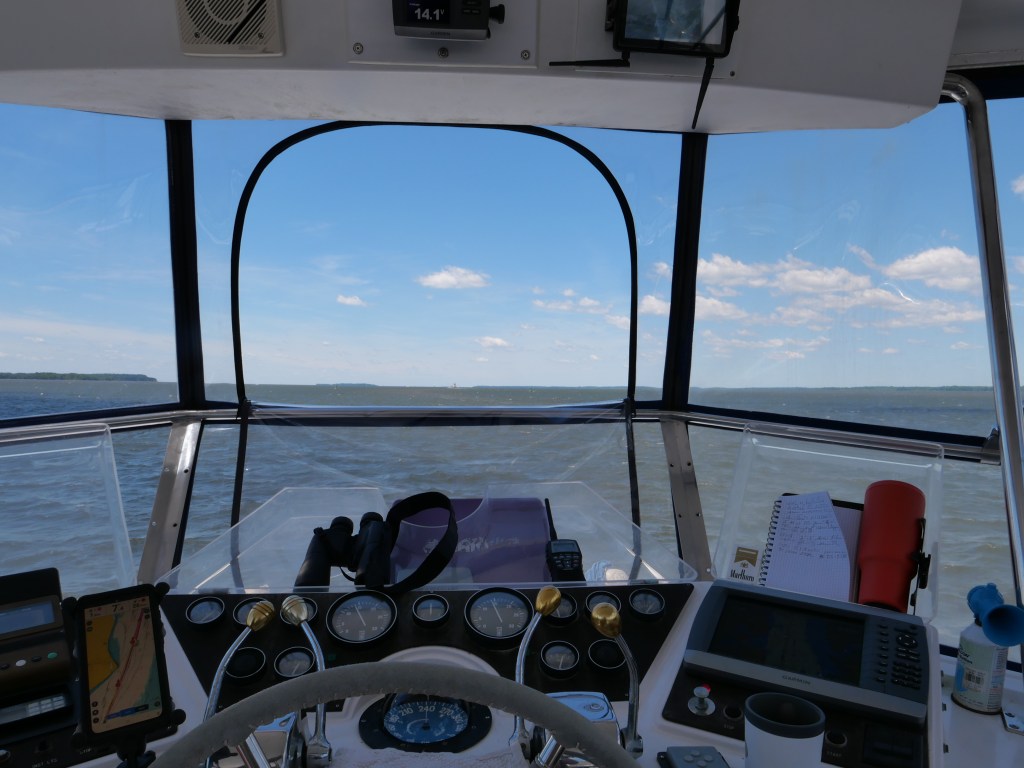
With a solid year of heavy wrenching under our belts, we finally cast off from our home slip at Podickory Point on Saturday morning under a completely blue sky. The upper bay was absolute glass—less than a foot of ripple. We officially spun the keys and had the engines on at 0900, getting everything warmed up before throwing the lines off at 0910. We settled into our 1500 RPM displacement cruise with a beautiful, cool breeze keeping things comfortable up on the flybridge.
If you look at the default routing on the Navionics app, it wanted to put us on an initial heading of 090° right out of the gate to kick us all the way over to the east side of the bay before turning north. The app does that to play it safe and keep you completely clear of the Baltimore Shoals. But standard algorithms don’t account for real local familiarity. Instead great little shortcut I learned from some local knowledge, allowing us to cleanly skirt right past the eastern edge of the shoals without wasting time or fuel on a massive dogleg.
What most people don’t realize about the Chesapeake Bay is how shallow it really is. Over 24% of the bay is less than six feet deep, so it’s absolutely vital to stay in the channel whenever you can. To pull that off safely, a good chartplotter and updated paper charts are highly recommended. And alongside those, you need a quality pair of binoculars for those moments when you are squinting through the glare trying to spot the next physical navaid.
As we pushed further up, the bay’s shallow dynamics showed up right on the electronics. When we hit Tolchester, I noticed an immediate 0.6-knot drop in our GPS speed over ground—a clear indicator of the local current patterns putting up a bit of resistance against our hull. By the time we trended past Mitchell Bluff, the breeze completely died down. The sun was out, but temperatures held at a really comfortable 75 to 80 degrees.
The coolest part of the run up was the approach to Chesapeake City. As we neared the back channel intersection, I pulled the throttles all the way down to a quiet 900 RPM to honor the no-wake zone, creeping along for a mile before the town and another half-mile past it. It was incredibly peaceful. We tied up at the Chesapeake Inn Marina right on time, plugged into shore power, let Jean-Luc stretch his legs, and watched the radar as the evening storms stayed well inland.
On Monday morning, we threw off the lines at 7:30 AM to beat an afternoon wind shift, and man, did we score on the canal current. Pushing just 1300 RPM, the eastbound flood current grabbed our stern and absolutely launched us. We were seeing an incredible 10.7 knots on the GPS!
We were instructed to call Delaware City Marina as soon as we reached the Reedy Point Bridge. When we rang them up, they gave us highly specific directions on exiting the C&D Canal and told us exactly when to flip over and contact the marina office on VHF Channel 9. Following their timeline, we contacted them on Channel 9 right as we cleared the canal and hit marker 6A on the Delaware River. The dockmaster advised us to make our turn in and gave us a very specific pilotage instruction: keep day beacon #1 between 25 and 40 feet directly off our port side to safely clear the shoaling.
We lined it up perfectly and slid right into the basin by 9:00 AM, and I have to tell you, the crew on the docks blew me away. Here we are, bringing a heavy, 22-ton vessel into the slips, and down on the docks are these two early-twenty-something girls waiting to catch our lines. I’m telling you, they handled our lines like absolute pros. When it came time to flip the boat around in the tight basin, Charley from the marina stood right there on the boards, completely cool and patient. He was simultaneously directing the girls with gentle instructions while giving me clear, calm directions over the VHF radio. I honestly cannot say enough good things about Delaware City Marina—their service and hospitality are unmatched. They are truly one of the best-run marinas I’ve seen in a very long time.
We were safe and dry long before the bay turned into a messy, square 25-knot chop. But look, you know how boating goes—especially when you’re pushing a platform to its limits to see what handles the stress. While we were tied up, the boat decided it was time to show us exactly what was next on the project list. We ran into a mechanical issue that required immediate, focused attention. It wasn’t something that put us in danger, but it was enough of a question mark that a good captain knows when a shakedown cruise has done its job. As much as we wanted to push south down the coast to Indian River and Cape Charles, turning back to handle it safely at our home port was the right call.
We officially threw the lines off to begin Leg 3 at 0720 on Saturday morning, June 20th. Before doing anything else, I pinned the throttles right up to 2500 RPM for a solid 10-minute stretch. When you spend that much time idling and displacement cruising, you have to aggressively blow out the carbon and give those turbos a chance to clear. Once that was finished, we turned back into the C&D Canal, dropping our turns down to a steady 1400 RPM cruise. We maintained that pace all the way through the morning until exactly 0930, when I throttled back a bit more and reduced our speed down to 1300 RPM.
Right around there, we saw our first very loud go-fast boat pass us on the C&D Canal—and boy, there were a lot more to come once we reached the Elk River. Honestly, it’d be nice if someone would introduce those guys to the concept of a muffler! Maybe when I was 20 years old I’d drool over a boat like that, but nowadays, I much prefer a quieter, slower pace on the water.
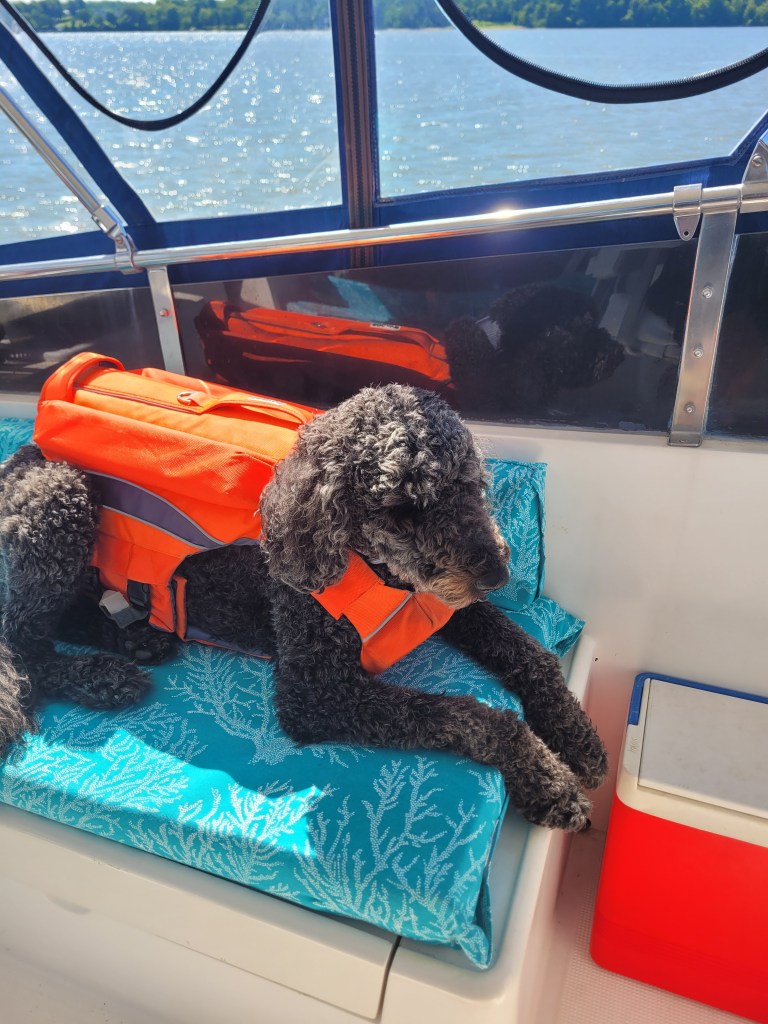
Jean-Luc, our standard poodle, was definitely not a fan of the high-decibel intrusion either. He clearly thought those loud go-fast boats were hostile pirate vessels and started barking up a storm, doing his absolute best to protect Sea Kelp from what he was convinced were shady buccaneers. We had to assure our furry first mate that the ship was safe before he finally stood down from battle stations.
We started taking on light, one-foot rollers coming in steadily from the east at 1045 AM. At that height, it was just enough to give Sea Kelp an easy, rhythmic lift—nothing she couldn’t glide through with ease, but a clear sign that we were leaving the protection of the river. Of course, it wouldn’t be a true weekend run on the water without a local center console fisherman out looking for his next catch. Somewhere right near the mouth of the Elk River, a 30-foot center console decided to aggressively cut right in front of us, crossing from our port to our starboard. Now, there is a very specific reason why a boat’s port navigation light is bright red: it means stop and give way. But this guy clearly missed that day of captain’s school.
Instead of yielding, he stood there waving his arms, frantically giving us hand gestures to indicate he had lines in the water. He was aggressively insisting that I turn my 22-ton cruiser to port just to protect his precious lures! Well, I wasn’t about to play chicken or risk a collision, so I immediately chopped the throttle down to idle to let him clear. Once our adventurous friend passed us by, I bumped the throttles back up to 1300 RPM and maintained our original course. Judging by the look on his face and his frantic final hand gestures as we watched him fade into our wake, I’m fairly certain he ended up losing a couple of very expensive lures to our running gear.
Right about the middle of the Elk River, we spotted a massive tug pushing a barge ahead of us. Talk about a lesson in scale—at our slower pace, it took a good two-plus hours from the time I first laid eyes on him until we finally crept past his beam. The encounter really hammered home one major upgrade I need to tackle next: installing an AIS (Automatic Identification System). By the time we got close enough for me to manually read the name on his hull to give him a shout on VHF Channel 13 for a standard bridge-to-bridge passing arrangement, I’m dead certain his radar was already sounding a proximity alarm. Getting AIS integrated on the flybridge is officially moving to the top of the winter project list.
Once we finally cleared his massive wake and found some open blue water ahead of us at exactly 11:25 AM, I bumped the throttles back up to 1400 RPM. This brought us right back to our efficient, steady displacement sweet spot, letting the twin Cats stretch their legs as we lined up our heading down the main spine of the bay.
This shakedown cruise also gave us the perfect opportunity to evaluate our gear list: what we used, what we didn’t use, and what we were glad we had. I keep a pretty comprehensive tool set onboard, including a wide array of battery-operated Ryobi power tools. But after this run, I realized there are some things I can safely take off the boat to save space—starting with my impact driver. I really don’t see a routine need for it out here. Honestly, I’ve only used it once to break loose some stubborn bolts when I was changing the belts and impellers on the Cats.
Instead, the real MVPs of the trip were the simpler tools. We ended up constantly relying on a small battery-operated air pump just to keep a bumper reinflated, and my trusty battery-operated clip-on fan was an absolute lifesaver when the wind completely died down and the cabin temperatures spiked into the mid-80s. As for the rest of the toolkit? It’s all staying right where it is. Because we’re running a mixed mechanical platform, we have to split our gear down the middle—the Caterpillar main engines require a full set of ASA standard bolts and nuts, while the Yanmar diesel engine on our generator is strictly metric. You can’t afford to be missing the right wrench when a mystery repair calls.
By exactly 12:54 PM, the bay showed us its true, nasty teeth. The logbook reads: 3-foot, 1-second seas with whitecaps. Now, if you aren’t a boater, a 3-foot wave might not sound like a crisis, but that 1-second wave period changes everything. It means those waves aren’t long, lazy ocean swells—they are steep, square, aggressive walls of water stacked right on top of each other, constantly punching the hull without giving the boat a chance to recover. Whitecaps were breaking everywhere, and it turned the bay into an absolute washboard.
Sea Kelp took the pounding like an absolute champ, her 22-ton displacement tracking straight through the mess while we held our 1400 RPM cruise speed down the channel centerline. Poor Jean-Luc actually got a bit seasick tossing around in those steep, square waves. He was looking pretty miserable for that stretch, but the second our home port of Podickory Point finally came into view, he perked right up like he knew the hard work was over.
When we reached our channel, we backed into our slip nice, slow, and easy, tying up exactly according to the methodical pre-docking plan Candy and I had mapped out. Once the lines were secured and the twin Cats went quiet, we took Jean-Luc straight down for a well-deserved walk on the grass.
We didn’t run the generator once this entire trip because the weather was great underway and we were plugged into shore power at each marina, keeping our fuel logging incredibly clean. We’re back home now, tied up safe, and the real fun begins—getting right back dirty in the engine room to resolve the mystery. At the end of the day, we learned a ton about the boat, completely dialed in our crew coordination, and we’re that much closer to having her bulletproof for the next launch. Stay tuned, because page 5 of the ships log is far from over.
 Adventures of Sea Kelp